International AS & A Level Mathematics 9709 at a glance
- Syllabus: Cambridge International AS & A Level Mathematics 9709, syllabus for 2026 and 2027.
- Components: Pure Mathematics (Papers 1, 2 and 3), Mechanics (Paper 4) and Probability & Statistics (Papers 5 and 6).
- Routes: The syllabus sets out three routes, including AS Level only and A Level staged over two years, and says candidates may combine components to suit their particular interests. Check the routes table in the syllabus for the combinations allowed.
Papers, marks and grading
| Paper | Time | Marks | Share of AS Level | Share of A Level |
|---|---|---|---|---|
| Paper 1 Pure Mathematics 1 | 1 hour 50 minutes | 75 | 60% | 30% |
| Paper 2 Pure Mathematics 2 | 1 hour 15 minutes | 50 | 40% | Only offered as part of AS Level |
| Paper 3 Pure Mathematics 3 | 1 hour 50 minutes | 75 | Not part of AS Level | 30% |
| Paper 4 Mechanics | 1 hour 15 minutes | 50 | 40% | 20% |
| Paper 5 Probability & Statistics 1 | 1 hour 15 minutes | 50 | 40% | 20% |
| Paper 6 Probability & Statistics 2 | 1 hour 15 minutes | 50 | Not part of AS Level | 20% |
All papers are written, structured-question examinations that are externally assessed. Paper 1 is compulsory for AS Level and A Level, and Paper 3 is compulsory for A Level. Calculator rules are given in Section 4 of the syllabus and the list of formulae (MF19) in Section 5, so check them for your series.
Topics in the syllabus
Each component has its own subject content. Examples of section titles from the syllabus:
| Component | Examples of topics |
|---|---|
| Pure Mathematics 1 | Quadratics; coordinate geometry; circular measure; differentiation |
| Pure Mathematics 2 | Algebra; integration; numerical solution of equations |
| Pure Mathematics 3 | Algebra; integration; vectors |
| Mechanics | Forces and equilibrium |
| Probability & Statistics 1 | Representation of data |
| Probability & Statistics 2 | The Poisson distribution |
Where students lose marks
- Differentiating correctly but forgetting to test whether a stationary point is a maximum or minimum.
- Losing the constant of integration on indefinite integrals.
- Dropping brackets when differentiating with the chain rule.
- Setting up a mechanics problem without a clear force diagram and sign convention.
- Rounding intermediate values in statistics problems, which changes the final probability.
- Treating Pure 1 as 'GCSE plus a bit'. The algebraic fluency expected is higher than at IGCSE.
These are common patterns, not an exhaustive list. A tutor can look at your own recent working to see which ones apply to you.
How online one-to-one lessons work
Lessons are one-to-one and online, 60 minutes each, at a time that suits your time zone. In the free 30-minute demo you share your subject, level and the topic you find hardest. The tutor works through a question with you, explains the method step by step, and you then try a similar question yourself. If you want to continue, we confirm the tutor, level and time with you. Tell us your syllabus code in the demo form and we confirm who can help before anything is arranged.
Worked example
Find the stationary points of y = x³ − 6x² + 5 and determine their nature. (An original practice question.)
- Differentiate: dy/dx = 3x² − 12x = 3x(x − 4).
- Set dy/dx = 0: x = 0 or x = 4.
- Find y: when x = 0, y = 5; when x = 4, y = 64 − 96 + 5 = −27.
- Second derivative: d²y/dx² = 6x − 12. At x = 0 this is −12 (a maximum); at x = 4 it is +12 (a minimum).
Answer: Maximum at (0, 5); minimum at (4, −27)
Online A Level Maths tutors at Learn All Students
One-to-one online lessons with a tutor who teaches A Level Maths. Book a free 30-minute demo to meet one.
 : Abdi Musa
 : Hashim Khan
Hashim Khan
PakistanComputer science, maths and physics for O Level, IGCSE and A Level
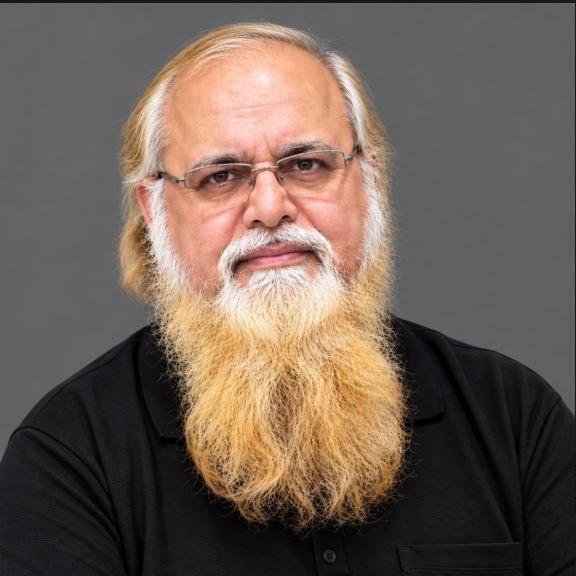 : Muhammad Mahmood Aslam Bhutta
Muhammad Mahmood Aslam Bhutta
PakistanMaths and Physics for GCSE, IGCSE, O Level, A Level and SAT
Price
A 60-minute one-to-one class costs from US$10 to US$18, depending on the level. The first 30-minute demo is free. Prices are in US dollars; other currencies are approximate.
Bands: US$10, US$13, US$18. See how classes, cancellation and refunds work.
Frequently asked questions
What papers make up A Level Maths 9709?
Pure Mathematics 1, 2 and 3 (Papers 1 to 3), Mechanics (Paper 4) and Probability & Statistics 1 and 2 (Papers 5 and 6). Which you sit depends on your route.
How long is Paper 1?
Paper 1 (Pure Mathematics 1) is 1 hour 50 minutes and 75 marks. It is compulsory for AS Level and A Level.
Which papers are compulsory?
Cambridge states that Paper 1 is compulsory for AS Level and A Level and Paper 3 is compulsory for A Level. The Mechanics and Probability & Statistics combinations depend on your route, so check the routes table in the syllabus.
Which syllabus years does this page cover?
The 2026 and 2027 syllabus. Check cambridgeinternational.org for later versions.
Can I try a Maths lesson before paying?
Yes. The first 30-minute demo is free and needs no payment details. A standard paid class is 60 minutes.
Do you teach syllabus 9709?
Tell us your syllabus code, level and topic in the free demo form. We confirm the tutor, level and time with you before anything is arranged.
Official sources
- Cambridge International AS & A Level Mathematics 9709 syllabus for 2026 and 2027 (official PDF) (checked 2026-11-17)
- Cambridge International: Cambridge International AS & A Level Mathematics 9709 (checked 2026-11-17)
Related pages
Try a free 30-minute demo
Work through a question with a tutor. No payment needed.
Request a free 30-minute demo