International AS & A Level Physics 9702 at a glance
- Syllabus: Cambridge International AS & A Level Physics 9702, syllabus for 2025, 2026 and 2027.
- Papers: Five papers. Papers 1, 2 and 3 are AS Level; Papers 4 and 5 are added for the full A Level.
- Routes: AS Level only (all AS components in one series), A Level staged over two years (AS Level first, then the remaining A Level papers), or A Level with all components in one series.
Papers, marks and grading
| Paper | Time | Marks | Share of AS Level | Share of A Level |
|---|---|---|---|---|
| Paper 1 Multiple Choice | 1 hour 15 minutes | 40 | 31% | 15.5% |
| Paper 2 AS Level Structured Questions | 1 hour 15 minutes | 60 | 46% | 23% |
| Paper 3 Advanced Practical Skills | 2 hours | 40 | 23% | 11.5% |
| Paper 4 A Level Structured Questions | 2 hours | 100 | Not part of AS Level | 38.5% |
| Paper 5 Planning, Analysis and Evaluation | 1 hour 15 minutes | 30 | Not part of AS Level | 11.5% |
Papers 1 and 2 are based on the AS Level syllabus content. Paper 4 is based on A Level content and requires knowledge of material from the AS Level syllabus. Papers 3 and 5 assess the experimental skills in the Practical assessment section of the syllabus, and their context may be outside the syllabus content. All papers are externally assessed.
Topics in the syllabus
The syllabus lists 25 topics. The first 11 are AS Level content and topics 12 to 25 are the A Level content.
| Level | Topics |
|---|---|
| AS Level | 1 Physical quantities and units; 2 Kinematics; 3 Dynamics; 4 Forces, density and pressure; 5 Work, energy and power; 6 Deformation of solids; 7 Waves; 8 Superposition; 9 Electricity; 10 D.C. circuits; 11 Particle physics |
| A Level | 12 Motion in a circle; 13 Gravitational fields; 14 Temperature; 15 Ideal gases; 16 Thermodynamics; 17 Oscillations; 18 Electric fields; 19 Capacitance; 20 Magnetic fields; 21 Alternating currents; 22 Quantum physics; 23 Nuclear physics; 24 Medical physics; 25 Astronomy and cosmology |
Where students lose marks
- Using equations of motion when acceleration is not constant (for example a falling object with air resistance).
- Mixing up vector and scalar quantities in momentum and kinematics problems.
- In planning questions, not identifying the independent, dependent and control variables first.
- Giving uncertainties in the wrong form, or not carrying them through to the final answer.
- Rounding early in multi-step circuit problems.
- Quoting the correct formula without defining the symbols when the question asks for a definition.
These are common patterns, not an exhaustive list. A tutor can look at your own recent working to see which ones apply to you.
How online one-to-one lessons work
Lessons are one-to-one and online, 60 minutes each, at a time that suits your time zone. In the free 30-minute demo you share your subject, level and the topic you find hardest. The tutor works through a question with you, explains the method step by step, and you then try a similar question yourself. If you want to continue, we confirm the tutor, level and time with you. Tell us your syllabus code in the demo form and we confirm who can help before anything is arranged.
Worked example
A 2.0 kg trolley moving at 3.0 m/s collides with a stationary 1.0 kg trolley and they stick together. Find their common speed and the kinetic energy lost. (An original practice question.)
- Momentum before = 2.0 × 3.0 = 6.0 kg m/s.
- Momentum after = (2.0 + 1.0) × v = 3.0v, so v = 6.0 ÷ 3.0 = 2.0 m/s.
- Kinetic energy before = ½ × 2.0 × 3.0² = 9.0 J; after = ½ × 3.0 × 2.0² = 6.0 J.
- Kinetic energy lost = 9.0 − 6.0 = 3.0 J.
Answer: Common speed 2.0 m/s; 3.0 J of kinetic energy lost
Online A Level Physics tutors at Learn All Students
One-to-one online lessons with a tutor who teaches A Level Physics. Book a free 30-minute demo to meet one.
 : Hashim Khan
Hashim Khan
PakistanComputer science, maths and physics for O Level, IGCSE and A Level
 : Muhammad Faisal
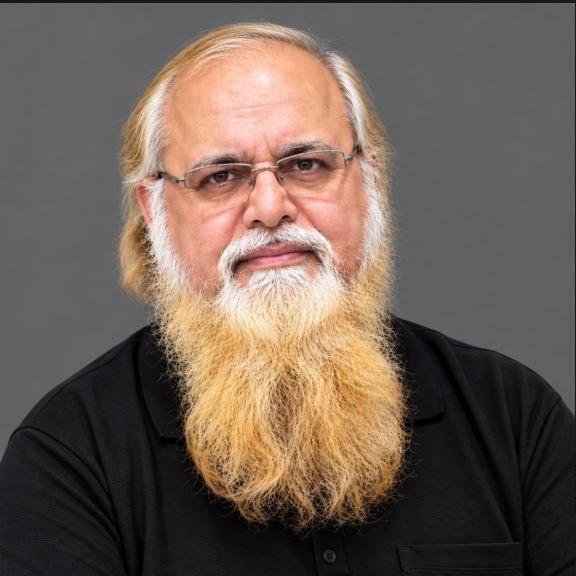 : Muhammad Mahmood Aslam Bhutta
Muhammad Mahmood Aslam Bhutta
PakistanMaths and Physics for GCSE, IGCSE, O Level, A Level and SAT
Price
A 60-minute one-to-one class costs from US$10 to US$18, depending on the level. The first 30-minute demo is free. Prices are in US dollars; other currencies are approximate.
Bands: US$10, US$13, US$18. See how classes, cancellation and refunds work.
Frequently asked questions
What are the papers in A Level Physics 9702?
Paper 1 (Multiple Choice), Paper 2 (AS Level Structured Questions), Paper 3 (Advanced Practical Skills), Paper 4 (A Level Structured Questions) and Paper 5 (Planning, Analysis and Evaluation).
How long and how many marks is Paper 4?
Paper 4 is 2 hours and 100 marks, and counts for 38.5% of the A Level.
How is AS Level different from A Level?
AS Level uses Papers 1, 2 and 3. A Level adds Papers 4 and 5 and recounts the AS papers at half their AS weighting.
Which syllabus years does this page cover?
The 2025, 2026 and 2027 syllabus. Check cambridgeinternational.org for a later version.
Can I try a Physics lesson before paying?
Yes. The first 30-minute demo is free and needs no payment details. A standard paid class is 60 minutes.
Do you teach syllabus 9702?
Tell us your syllabus code, level and topic in the free demo form. We confirm the tutor, level and time with you before anything is arranged.
Official sources
- Cambridge International AS & A Level Physics 9702 syllabus for 2025, 2026 and 2027 (official PDF) (checked 2026-11-17)
- Cambridge International: Cambridge International AS & A Level Physics 9702 (checked 2026-11-17)
Related pages
Try a free 30-minute demo
Work through a question with a tutor. No payment needed.
Request a free 30-minute demo