AQA, Pearson Edexcel and OCR at a glance
- Qualification: GCSE Mathematics, graded 1 to 9 (9 is the best grade); below the grade 1 standard a student is recorded as U (unclassified). Source: AQA specification, section 5.3.
- Tiers (AQA 8300): Foundation tier covers grades 1 to 5 and Higher tier covers grades 4 to 9. A student takes all three papers at the same tier, in the same exam series.
- Papers (AQA 8300): Three written papers. Paper 1 is non-calculator; Papers 2 and 3 allow a calculator. Each paper is 1 hour 30 minutes and 80 marks, and counts for 33% of the assessment. Content from any part of the specification can appear on any paper.
- Assessment objectives (AQA 8300): Foundation tier: AO1 50%, AO2 25%, AO3 25%. Higher tier: AO1 40%, AO2 30%, AO3 30%.
- Edexcel and OCR: Pearson Edexcel and OCR also offer GCSE Maths. Check your own board's specification for paper times and marks: this page does not quote them.
Topics in the AQA GCSE Maths specification
The AQA specification groups the content into six areas. The headings below are taken from the specification's contents page.
| Area | Sections in the specification |
|---|---|
| Number | Structure and calculation; fractions, decimals and percentages; measures and accuracy |
| Algebra | Notation, vocabulary and manipulation; graphs; solving equations and inequalities; sequences |
| Ratio, proportion and rates of change | Ratio, proportion and rates of change |
| Geometry and measures | Properties and constructions; mensuration and calculation; vectors |
| Probability | Probability |
| Statistics | Statistics |
Because every paper can assess any part of the specification, a gap in one area can cost marks on all three papers. A tutor can find the gap with you in the demo and then keep returning to it.
How much each topic is worth
The AQA specification states that the weighting of the topic areas is prescribed by Ofqual and is common to all exam boards. The figures are approximate and apply to the whole tier, not to a single paper.
| Topic area | Foundation tier (%) | Higher tier (%) |
|---|---|---|
| Number | 25 | 15 |
| Algebra | 20 | 30 |
| Ratio | 25 | 20 |
| Geometry | 15 | 20 |
| Probability and statistics (combined) | 15 | 15 |
Read the table as a guide to where to spend revision time. A Foundation student gets about a quarter of the marks from Number and a quarter from Ratio. A Higher student gets about 30% from Algebra, so fluent algebra is the biggest single lever at that tier.
Foundation or Higher: which tier?
The tiers overlap at grades 4 and 5, which is why the choice matters. Foundation tier covers grades 1 to 5 only, so a Foundation student cannot reach grade 6 or above. Higher tier covers grades 4 to 9, so it is the route to the top grades. Ask your teacher how a result just below grade 4 would be treated at Higher tier.
- Ask your school which tier you are entered for and when the entry is final.
- Use recent mock results from your school, not a single paper, to judge the level.
- A tutor can work through Higher-tier questions with you in the demo so you can see how they feel before the decision.
Where students lose marks
- Sign errors when a bracket is multiplied out or a term moves across an equals sign: for 3(x − 2) = 2x + 5, forgetting that −2 × 3 gives −6.
- Cancelling terms instead of factors in algebraic fractions, for example treating (x + 4)/4 as x + 1.
- Rounding too early in a multi-step calculation. Keep full calculator values until the final line, then round once.
- Percentage change taken from the wrong starting value. The original amount is always the base, not the new amount.
- Skipping working on Paper 1. With no calculator and 80 marks, method marks are often the difference between a grade and the one below.
- Reading a question once. Underline what is asked (an exact value, a given number of significant figures, units) before starting.
These are common patterns, not an exhaustive list. A tutor can check your own recent working to see which ones apply to you.
How online one-to-one lessons work
Lessons are one-to-one and online, 60 minutes each, at a time that suits your time zone. In the free 30-minute demo you share your board, tier and the topic you find hardest. The tutor works through a question with you, explains the method step by step, and then you try a similar question yourself. If you want to continue, we confirm the tutor, level and time with you and agree a plan. Our tutors are shown by subject and level; tell us your exam board in the demo form and we confirm who can help.
Worked example
Solve 3(x − 2) = 2x + 5. (An original practice question, not taken from a past paper.)
- Multiply out the bracket: 3x − 6 = 2x + 5.
- Subtract 2x from both sides so the x terms are together: x − 6 = 5.
- Add 6 to both sides: x = 11.
- Check by substituting: 3(11 − 2) = 27 and 2(11) + 5 = 27, so both sides match.
Answer: x = 11
Online GCSE Maths tutors at Learn All Students
One-to-one online lessons with a tutor who teaches GCSE Maths. Book a free 30-minute demo to meet one.
 : Abdi Musa
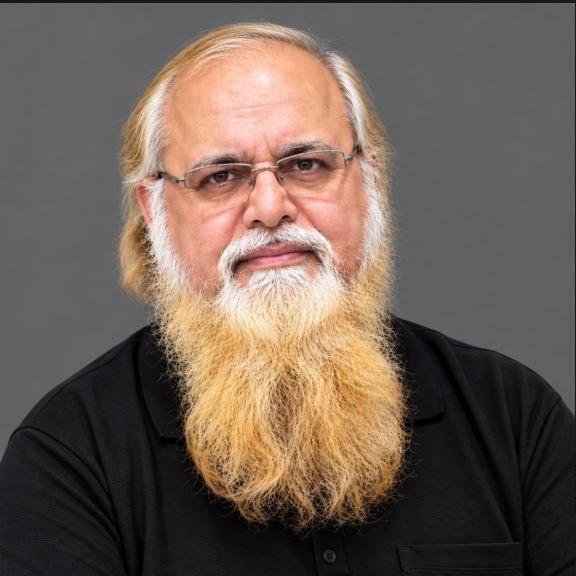 : Muhammad Mahmood Aslam Bhutta
Muhammad Mahmood Aslam Bhutta
PakistanMaths and Physics for GCSE, IGCSE, O Level, A Level and SAT
Price
A 60-minute one-to-one class costs from US$10 to US$18, depending on the level. The first 30-minute demo is free. Prices are in US dollars; other currencies are approximate.
Bands: US$10, US$13, US$18. See how classes, cancellation and refunds work.
Frequently asked questions
What are the tiers in GCSE Maths?
For AQA GCSE Maths (8300), Foundation tier covers grades 1 to 5 and Higher tier covers grades 4 to 9. Students take all three papers at one tier.
How many papers are there and is a calculator allowed?
For AQA, there are three papers. Paper 1 is non-calculator and Papers 2 and 3 allow a calculator. Check your own board's specification if you sit Edexcel or OCR.
How long are the AQA GCSE Maths papers?
Each AQA paper is 1 hour 30 minutes and 80 marks, and each counts for 33% of the assessment.
How is GCSE Maths graded?
On a nine-point scale from 1 to 9, where 9 is the best grade. Below the grade 1 standard a student is recorded as U (unclassified).
Can I try a lesson before paying?
Yes. The first 30-minute demo is free and needs no payment details. A standard paid class is 60 minutes.
Do you teach my exam board?
Tell us your board, tier and topic in the free demo form. We confirm the tutor, level and time with you before anything is arranged.
Official sources
- AQA GCSE Mathematics (8300) specification, version 1.0 (AQA advises checking aqa.org.uk/8300 for the latest version) (checked 2026-11-17)
- AQA GCSE Mathematics 8300: scheme of assessment (checked 2026-11-17)
- GOV.UK: GCSE 9 to 1 grade scale explained (published 30 June 2025) (checked 2026-11-17)
Related pages
Try a free 30-minute demo
Work through a question with a tutor. No payment needed.
Request a free 30-minute demo