IGCSE Physics 0625 at a glance
- Syllabus: Cambridge IGCSE Physics 0625, syllabus for 2026, 2027 and 2028 (latest version 2, published December 2025 as stated in the syllabus).
- Papers: Three papers per candidate: a multiple-choice paper, a theory paper and one practical paper from a choice of two.
- Grades: Core candidates are eligible for grades C to G. Extended candidates (Core and Supplement content) are eligible for grades A* to G.
Papers, marks and grading
| Paper | Type | Time | Marks | Weighting |
|---|---|---|---|---|
| Paper 1 (Core) | Multiple choice, 40 four-option questions | 45 minutes | 40 | 30% |
| Paper 3 (Core) | Theory: short-answer and structured | 1 hour 15 minutes | 80 | 50% |
| Paper 2 (Extended) | Multiple choice, 40 four-option questions | 45 minutes | 40 | 30% |
| Paper 4 (Extended) | Theory: short-answer and structured | 1 hour 15 minutes | 80 | 50% |
| Paper 5 | Practical Test | 1 hour 15 minutes | 40 | 20% |
| Paper 6 | Alternative to Practical | 1 hour | 40 | 20% |
Core candidates take Papers 1 and 3 and either Paper 5 or Paper 6. Extended candidates take Papers 2 and 4 and either Paper 5 or Paper 6. Both practical papers are based on the experimental skills in Section 4 of the syllabus. Cambridge says availability of each option is explained in the Before you start section of the syllabus.
Topics in the syllabus
The subject content has six areas. Examples of section titles inside them are given in brackets.
| Topic area | Examples of sections |
|---|---|
| 1 Motion, forces and energy | Physical quantities and measurement techniques; Motion; Mass and weight; Density; Energy, work and power; Pressure |
| 2 Thermal physics | Kinetic particle model of matter; Thermal properties and temperature; Transfer of thermal energy |
| 3 Waves | Light (section 3.2) and other wave topics |
| 4 Electricity and magnetism | Simple phenomena of magnetism; Electrical quantities |
| 5 Nuclear physics | Radioactivity |
| 6 Space physics | Stars and the Universe |
Where students lose marks
- Forgetting to convert units (for example grams to kilograms, centimetres to metres) before substituting into an equation.
- Quoting an equation but not showing the substitution, so a slip loses method marks as well as the answer.
- Mixing up speed and velocity, or mass and weight, in explanations that need the precise term.
- Reading a graph gradient without using the scale on both axes, so the units come out wrong.
- In the practical paper, writing results without a unit in the column heading, or plotting points without a sensible scale.
- Explaining a phenomenon in everyday language when the question asks for the physics term.
These are common patterns, not an exhaustive list. A tutor can look at your own recent working to see which ones apply to you.
How online one-to-one lessons work
Lessons are one-to-one and online, 60 minutes each, at a time that suits your time zone. In the free 30-minute demo you share your subject, level and the topic you find hardest. The tutor works through a question with you, explains the method step by step, and you then try a similar question yourself. If you want to continue, we confirm the tutor, level and time with you. Tell us your syllabus code in the demo form and we confirm who can help before anything is arranged.
Worked example
A car accelerates from rest at 2.5 m/s² for 8.0 s. Find its final speed and the distance travelled. (An original practice question.)
- Write down what is known: u = 0, a = 2.5 m/s², t = 8.0 s.
- Final speed: v = u + at = 0 + 2.5 × 8.0 = 20 m/s.
- Distance: s = ut + ½at² = 0 + ½ × 2.5 × 8.0² = 0.5 × 2.5 × 64 = 80 m.
- Check: average speed is (0 + 20) ÷ 2 = 10 m/s, and 10 × 8.0 = 80 m, which matches.
Answer: Final speed 20 m/s; distance 80 m
Online IGCSE Physics tutors at Learn All Students
One-to-one online lessons with a tutor who teaches IGCSE Physics. Book a free 30-minute demo to meet one.
 : Hashim Khan
Hashim Khan
PakistanComputer science, maths and physics for O Level, IGCSE and A Level
 : Muhammad Faisal
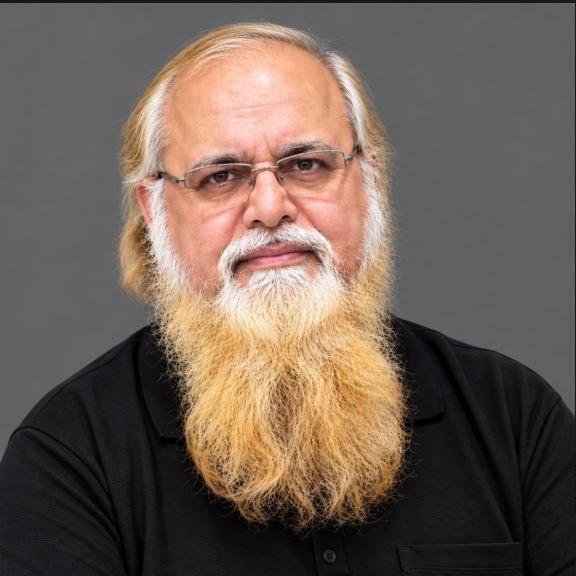 : Muhammad Mahmood Aslam Bhutta
Muhammad Mahmood Aslam Bhutta
PakistanMaths and Physics for GCSE, IGCSE, O Level, A Level and SAT
Price
A 60-minute one-to-one class costs from US$10 to US$18, depending on the level. The first 30-minute demo is free. Prices are in US dollars; other currencies are approximate.
Bands: US$10, US$13, US$18. See how classes, cancellation and refunds work.
Frequently asked questions
What are the papers in IGCSE Physics 0625?
Core candidates take Papers 1 and 3, and Extended candidates take Papers 2 and 4. All candidates also take either Paper 5 (Practical Test) or Paper 6 (Alternative to Practical).
How long are the theory papers?
Paper 1 and Paper 2 are 45 minutes and 40 marks. Paper 3 and Paper 4 are 1 hour 15 minutes and 80 marks.
How long are the practical papers?
Paper 5 (Practical Test) is 1 hour 15 minutes and 40 marks. Paper 6 (Alternative to Practical) is 1 hour and 40 marks. Each counts for 20%.
Which grades can Core and Extended candidates get?
Core candidates are eligible for grades C to G and Extended candidates for grades A* to G.
Can I try a Physics lesson before paying?
Yes. The first 30-minute demo is free and needs no payment details. A standard paid class is 60 minutes.
Do you teach syllabus 0625?
Tell us your syllabus code, level and topic in the free demo form. We confirm the tutor, level and time with you before anything is arranged.
Official sources
- Cambridge IGCSE Physics 0625 syllabus for 2026, 2027 and 2028 (official PDF) (checked 2026-11-17)
- Cambridge International: Cambridge IGCSE Physics 0625 (checked 2026-11-17)
Related pages
Try a free 30-minute demo
Work through a question with a tutor. No payment needed.
Request a free 30-minute demo