IGCSE Mathematics 0580 at a glance
- Syllabus: Cambridge IGCSE Mathematics 0580, syllabus for 2025, 2026 and 2027 (latest version 3, published May 2024 as stated in the syllabus).
- Papers: Two papers per candidate. Core candidates take Paper 1 and Paper 3. Extended candidates take Paper 2 and Paper 4.
- Calculators: A scientific calculator is required for Paper 3 and Paper 4. Calculators are not allowed for Paper 1 and Paper 2.
- Grades: Core candidates are eligible for grades C to G. Extended candidates are eligible for grades A* to E.
Papers, marks and grading
| Paper | Calculator | Time | Marks | Weighting |
|---|---|---|---|---|
| Paper 1 (Core) | Not allowed | 1 hour 30 minutes | 80 | 50% |
| Paper 3 (Core) | Required | 1 hour 30 minutes | 80 | 50% |
| Paper 2 (Extended) | Not allowed | 2 hours | 100 | 50% |
| Paper 4 (Extended) | Required | 2 hours | 100 | 50% |
All papers have structured and unstructured questions and are externally assessed. Cambridge says candidates who have studied the Core content, or who are expected to achieve a grade D or below, should be entered for Papers 1 and 3. Candidates who have studied the Extended content and are expected to achieve a grade C or above should be entered for Papers 2 and 4.
Topics in the syllabus
The syllabus content is grouped into nine topic areas. Ask your teacher which items are Core only and which are Extended.
| Topic area | Typical focus for practice |
|---|---|
| 1 Number | Fractions, percentages, ratio, standard form, bounds |
| 2 Algebra and graphs | Equations, inequalities, sequences, functions, sketching graphs |
| 3 Coordinate geometry | Gradients, lines and midpoints |
| 4 Geometry | Angles, circle theorems, similarity, constructions |
| 5 Mensuration | Perimeter, area, volume and surface area |
| 6 Trigonometry | Right-angled triangles and non-right-angled triangles |
| 7 Transformations and vectors | Reflection, rotation, enlargement, vector notation |
| 8 Probability | Single and combined events |
| 9 Statistics | Averages, charts, cumulative frequency |
Where students lose marks
- Using a calculator method on Paper 1 or Paper 2, where calculators are not allowed. Practise exact fractions, surds and mental checks.
- Rounding too early in a long calculation. Keep full calculator values and round once at the end.
- Sign errors when multiplying out brackets or moving terms across an equals sign.
- Giving a final answer without units or to the wrong accuracy when the question specifies significant figures.
- Skipping working. On structured questions, method marks are awarded even when the final answer is wrong.
- Entering the Extended papers without secure algebra. Weak algebra loses marks across several topic areas at once.
These are common patterns, not an exhaustive list. A tutor can look at your own recent working to see which ones apply to you.
How online one-to-one lessons work
Lessons are one-to-one and online, 60 minutes each, at a time that suits your time zone. In the free 30-minute demo you share your subject, level and the topic you find hardest. The tutor works through a question with you, explains the method step by step, and you then try a similar question yourself. If you want to continue, we confirm the tutor, level and time with you. Tell us your syllabus code in the demo form and we confirm who can help before anything is arranged.
Worked example
Solve 2x² − 7x + 3 = 0. (An original practice question, not taken from a past paper.)
- Look for two numbers that multiply to 2 × 3 = 6 and add to −7: they are −1 and −6.
- Split the middle term: 2x² − x − 6x + 3 = 0.
- Factorise in pairs: x(2x − 1) − 3(2x − 1) = 0, so (2x − 1)(x − 3) = 0.
- Set each bracket to zero: 2x − 1 = 0 gives x = 1/2, and x − 3 = 0 gives x = 3.
Answer: x = 1/2 or x = 3
Online IGCSE Maths tutors at Learn All Students
One-to-one online lessons with a tutor who teaches IGCSE Maths. Book a free 30-minute demo to meet one.
 : Hashim Khan
Hashim Khan
PakistanComputer science, maths and physics for O Level, IGCSE and A Level
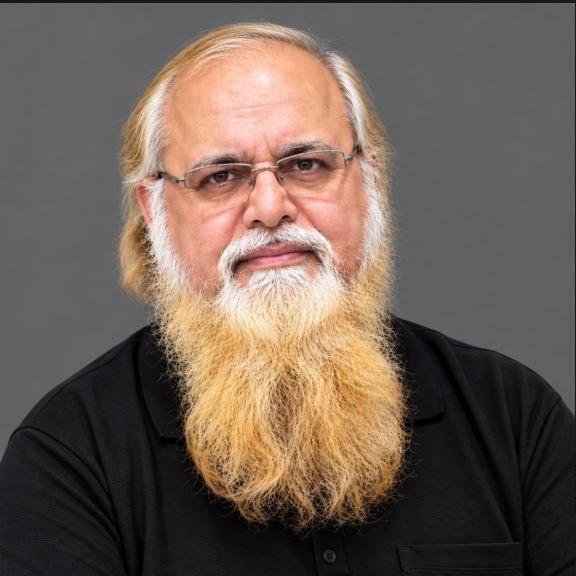 : Muhammad Mahmood Aslam Bhutta
Muhammad Mahmood Aslam Bhutta
PakistanMaths and Physics for GCSE, IGCSE, O Level, A Level and SAT
Price
A 60-minute one-to-one class costs from US$10 to US$18, depending on the level. The first 30-minute demo is free. Prices are in US dollars; other currencies are approximate.
Bands: US$10, US$13, US$18. See how classes, cancellation and refunds work.
Frequently asked questions
What is the difference between Core and Extended?
Cambridge states that Core candidates take Papers 1 and 3 and are eligible for grades C to G, while Extended candidates take Papers 2 and 4 and are eligible for grades A* to E.
How long are the IGCSE Maths 0580 papers?
Papers 1 and 3 (Core) are 1 hour 30 minutes and 80 marks each. Papers 2 and 4 (Extended) are 2 hours and 100 marks each.
Which papers allow a calculator?
Paper 3 and Paper 4 require a scientific calculator. Calculators are not allowed for Paper 1 and Paper 2.
Which syllabus years does this page cover?
The 2025, 2026 and 2027 syllabus. Check cambridgeinternational.org for any later version before you rely on a detail.
Can I try a Maths lesson before paying?
Yes. The first 30-minute demo is free and needs no payment details. A standard paid class is 60 minutes.
Do you teach syllabus 0580?
Tell us your syllabus code, level and topic in the free demo form. We confirm the tutor, level and time with you before anything is arranged.
Official sources
- Cambridge IGCSE Mathematics 0580 syllabus for 2025, 2026 and 2027 (official PDF) (checked 2026-11-17)
- Cambridge International: Cambridge IGCSE Mathematics 0580 (checked 2026-11-17)
Related pages
Try a free 30-minute demo
Work through a question with a tutor. No payment needed.
Request a free 30-minute demo